How to Convert Hourly Rate to Annual Salary Free Calculator

You're sitting across from a hiring manager. The job sounds great. The company seems solid. Then they mention the role pays $22 an hour. You nod, smile, and think: what does this number add up to each year? You run a quick mental calculation, draw a blank, and walk out still unsure whether the offer was worth accepting.
Most people have been in this exact spot. Knowing how to convert an hourly rate to annual salary removes the confusion entirely. This article walks you through the exact formula, real examples at different pay rates, adjustments for taxes and time off, and every angle worth knowing before you sign anything.
The Simple Formula to Convert Hourly Rate to Annual Salary
The math here is refreshingly simple. A standard full-time schedule runs 40 hours per week across 52 weeks per year. Multiply those two numbers and you get 2,080 working hours annually.
The Core Formula: Annual Salary = Hourly Rate x 2,080
Every employer, recruiter, and accountant uses this number when converting hourly wages to annual pay. Here's how it looks in practice across four common pay rates.
Real Calculation Examples
Situation: $15/hour, full-time (40 hrs/week) Calculation: $15 x 2,080 = $31,200/year
Situation: $20/hour, full-time Calculation: $20 x 2,080 = $41,600/year
Situation: $25/hour, full-time Calculation: $25 x 2,080 = $52,000/year
Situation: $35/hour, full-time Calculation: $35 x 2,080 = $72,800/year
The formula works across currencies too. Whether you earn in USD, GBP, AUD, or PKR, multiply your hourly rate by 2,080 for any standard full-time annual figure. Simple, reliable, and consistent across the board.
Read Also: Understanding Exchange Rates: A Complete Guide
How to Use the Free Hourly to Annual Salary Calculator
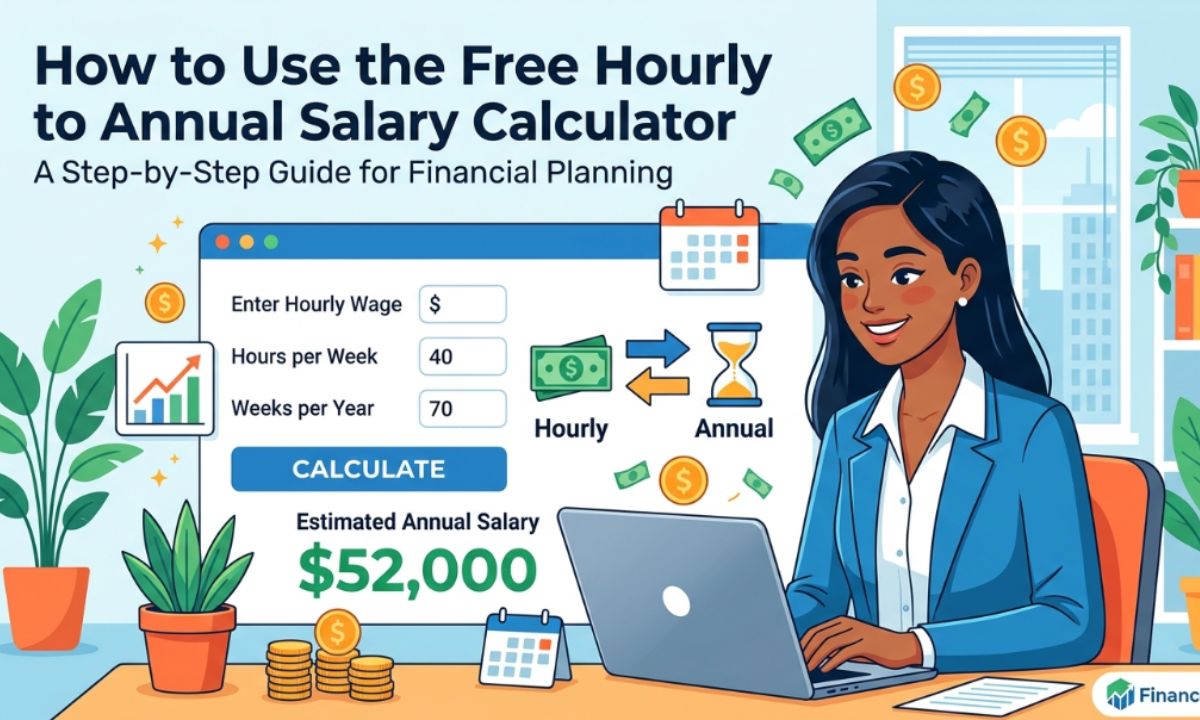
Doing the math by hand is quick for one number. When you're comparing several offers at once, or adjusting for different hour scenarios, a dedicated tool saves meaningful time.
The free Salary Calculator at QuickConvertIO handles this instantly. Enter your hourly rate, your weekly hours, and the number of weeks you work per year. The tool delivers your annual figure in seconds, with no signup required.
Here's when a calculator beats mental math every time:
Comparing two job offers with different hourly rates side by side
Calculating income for non-standard schedules (28 or 45 hours per week)
Running "what if" scenarios before a salary negotiation
Checking whether a small raise meaningfully changes your annual income
Estimating earnings for a part-time role alongside full-time work
The calculator runs on mobile too, so you're able to pull up numbers right in the car before walking into an interview. No excuses for walking in unprepared.
What If You Don't Work 40 Hours a Week?
Not every role fits the standard 40-hour mold. Part-time workers, shift employees, and those with variable schedules all need to adjust the base formula before the number means anything useful.
Part-Time Hourly to Annual Conversion
The formula stays exactly the same. Swap out 40 for your actual weekly hours.
Adjusted Formula: Annual Salary = Hourly Rate x Your Weekly Hours x 52
Here are two part-time examples:
Situation: $18/hour at 25 hours/week Calculation: $18 x 25 x 52 = $23,400/year
Situation: $22/hour at 30 hours/week Calculation: $22 x 30 x 52 = $34,320/year
Overtime Pay
Regular overtime pushes your annual total much higher than the base figure suggests. Under US labor law, hourly workers earn 1.5x their regular rate for every hour beyond 40 in a single workweek.
Situation: $20/hour with 5 hours of overtime weekly Regular pay: $20 x 40 x 52 = $41,600 Overtime pay: $30 x 5 x 52 = $7,800 Total: $49,400/year
Nearly $8,000 more than the base figure. Most online salary comparison tools ignore overtime entirely, which leads hourly workers in overtime-heavy roles to seriously underestimate their own annual earnings.
Hourly Rate to Annual Salary Before and After Taxes
The number the formula produces is your gross salary. What arrives in your bank account each month is your net salary, and the gap between the two is significant enough to change how you evaluate any offer.
Gross vs. Net: What the Numbers Look Like
Federal income tax in the US ranges from 10% to 37% depending on your bracket. Social Security and Medicare take a combined 7.65% on top of income tax. State taxes vary across each state on top of those.
Here's a simplified overview using a flat 25% total deduction estimate:
Hourly Rate Gross Annual Salary Estimated Net (After ~25% Tax) $15/hour $31,200 ~$23,400 $20/hour $41,600 ~$31,200 $30/hour $62,400 ~$46,800 $40/hour $83,200 ~$62,400
These figures are estimates. Your actual take-home depends on your filing status, your state, and your deductions. The gross figure gives you a reliable starting point for any comparison, and you should always follow up with a tax-specific calculator if you need precision.
Common Hourly Wages and What They Look Like Annually
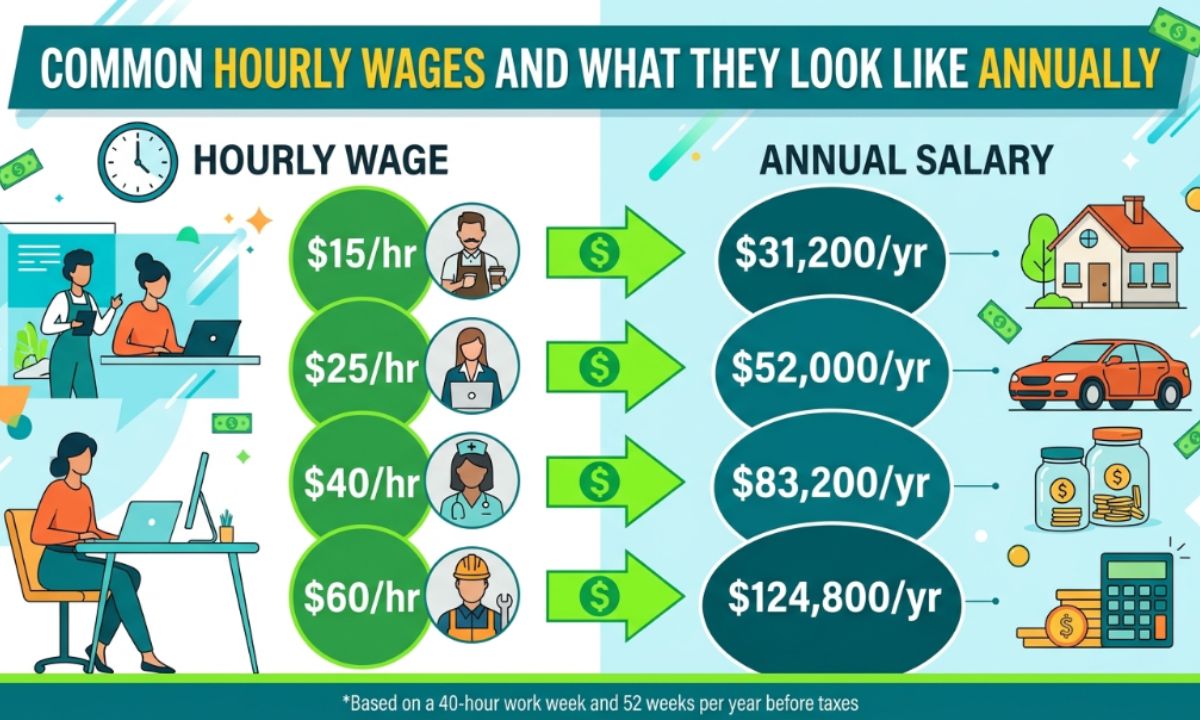
One of the most frequently searched questions online is: "What does $X per hour work out to each year?" The table below covers a wide range of hourly rates at a standard 40-hour full-time schedule, saving you the calculation for every common wage point.
Hourly Rate Annual Salary (40 hrs/week) $12/hour $24,960/year $15/hour $31,200/year $18/hour $37,440/year $20/hour $41,600/year $22/hour $45,760/year $25/hour $52,000/year $28/hour $58,240/year $30/hour $62,400/year $35/hour $72,800/year $40/hour $83,200/year $45/hour $93,600/year $50/hour $104,000/year
Bookmark this table. It answers the hourly rate to annual salary question for every common wage point without requiring any extra math on your end.
Hourly vs. Salary Jobs: Which One Pays More in the Long Run?
This question comes up every time someone weighs an hourly role against a salaried position. The honest answer is: it depends on more than the number on the offer letter.
The Upside of Hourly Work
Hourly employees earn compensation for every hour they put in. Work extra hours, earn extra pay. Overtime protection means employers compensate you more for overwork, not less. The rules are transparent, and your income grows directly with your time.
The Hidden Cost of Salaried Work
Salaried employees earn the same amount each week regardless of hours spent on the job. A $52,000 annual salary looks identical to $25/hour on paper. Work 50 hours each week instead of 40, though, and your effective hourly rate drops to $20/hour.
Here's a side-by-side comparison:
Scenario Effective Hourly Rate Salary $52,000, works 40 hrs/week $25.00/hour Salary $52,000, works 50 hrs/week $20.00/hour Hourly $25 + 5 hrs overtime weekly ~$28.85 effective
When evaluating any offer, run the hourly rate to annual salary conversion in both directions. Convert salaries to effective hourly rates and hourly wages to annual totals, then factor in your actual expected working hours before deciding.
How to Factor in Paid Time Off and Holidays
Here's what most hourly-to-salary articles skip entirely: the 2,080-hour figure assumes you work every single week of the year with zero time off. For most workers, this is not how a calendar year plays out.
A standard US full-time position often includes 10 days of paid vacation plus around 10 federal holidays. Add those together and you lose 20 paid days per year, equal to 160 fewer hours on the clock. Your annual salary stays the same, but your effective hourly rate rises because your employer pays you for days you don't work.
Adjusted Formula: Actual working hours = 2,080 minus (paid days off x 8 hours)
Example: 20 days off x 8 hours = 160 hours Actual working hours: 2,080 minus 160 = 1,920
For a $52,000 annual salary: $52,000 / 1,920 = $27.08 effective hourly rate (versus $25/hour on paper)
Common Mistake: Many job seekers compare a salaried position's base pay to an hourly rate without adjusting for paid leave. A role with generous PTO is worth more than the listed salary suggests. Always account for the full package, not the headline number.
Read Also: $20 an Hour Is How Much a Year? (2026 Salary Breakdown)
Converting Hourly Rate to Annual Salary for Freelancers and Contractors

Freelancers have a more layered version of this calculation. Hours shift by week, projects come and go, and there's no employer covering half your Social Security contribution. Treating your hourly rate the same way a salaried employee would leads to a distorted picture of your actual income.
The Self-Employment Tax Factor
As a US freelancer, you pay the full 15.3% self-employment tax on top of regular income tax. This means your gross annual figure requires a larger adjustment before you arrive at a realistic take-home number.
Example: $35/hour freelancer, averaging 30 billable hours per week for 48 weeks per year: $35 x 30 x 48 = $50,400 gross After approximately 35% total tax: ~$32,760 net
At $35/hour, a freelancer nets less than a salaried employee earning the same gross figure. The self-employment tax and the lack of employer benefits make a meaningful difference.
Estimating Income With Variable Hours
For anyone whose hours shift week to week, this method gives a reliable annual estimate:
Track your average billable hours over three consecutive months
Multiply the monthly average by 4 to get a consistent weekly figure
Multiply your weekly hours by 52 for an annual projection
You're able to test different hour scenarios in seconds with the free Salary Calculator at QuickConvertIO. The tool accepts any weekly hour input, making it ideal for freelancers with irregular schedules.
FAQ
How do I convert my hourly wage to an annual salary?
Multiply your hourly rate by 2,080 (40 hours x 52 weeks). At $20/hour, the calculation is $20 x 2,080 = $41,600 per year before taxes. For part-time work, replace 40 with your actual weekly hours.
What is $20 an hour annually?
At a standard 40-hour week, $20/hour works out to $41,600 per year before taxes. After federal and state deductions, take-home pay varies by location and filing status, but expect somewhere between $30,000 and $33,000 net.
Does the hourly to annual salary formula change for part-time workers?
Yes. Replace the 40-hour weekly figure with your actual hours. Working 25 hours per week at $18/hour gives you $18 x 25 x 52 = $23,400 per year. The core formula stays the same; only the hour input changes.
How do taxes affect my hourly rate to annual salary conversion?
The standard formula produces your gross pre-tax amount. Federal income tax, state tax, Social Security, and Medicare all reduce what you take home. Budget for roughly 20 to 30 percent in total deductions depending on your income level and state.
How do freelancers calculate annual income from an hourly rate?
Multiply your hourly rate by your average weekly billable hours, then by weeks worked per year. As a US freelancer, subtract self-employment tax (15.3%) and regular income tax before comparing your effective rate to any salaried position.
Conclusion
Next time a job offer lands on your desk with an hourly rate attached, you'll know how to convert it to an annual figure, adjust for your real working hours, account for taxes and paid leave, and weigh it against any salaried alternative. The formula takes seconds once you've seen it. For anything more complex, the free Salary Calculator at QuickConvertIO gives you the answer without the mental gymnastics.