Metric vs Imperial: Why the World Cannot Agree
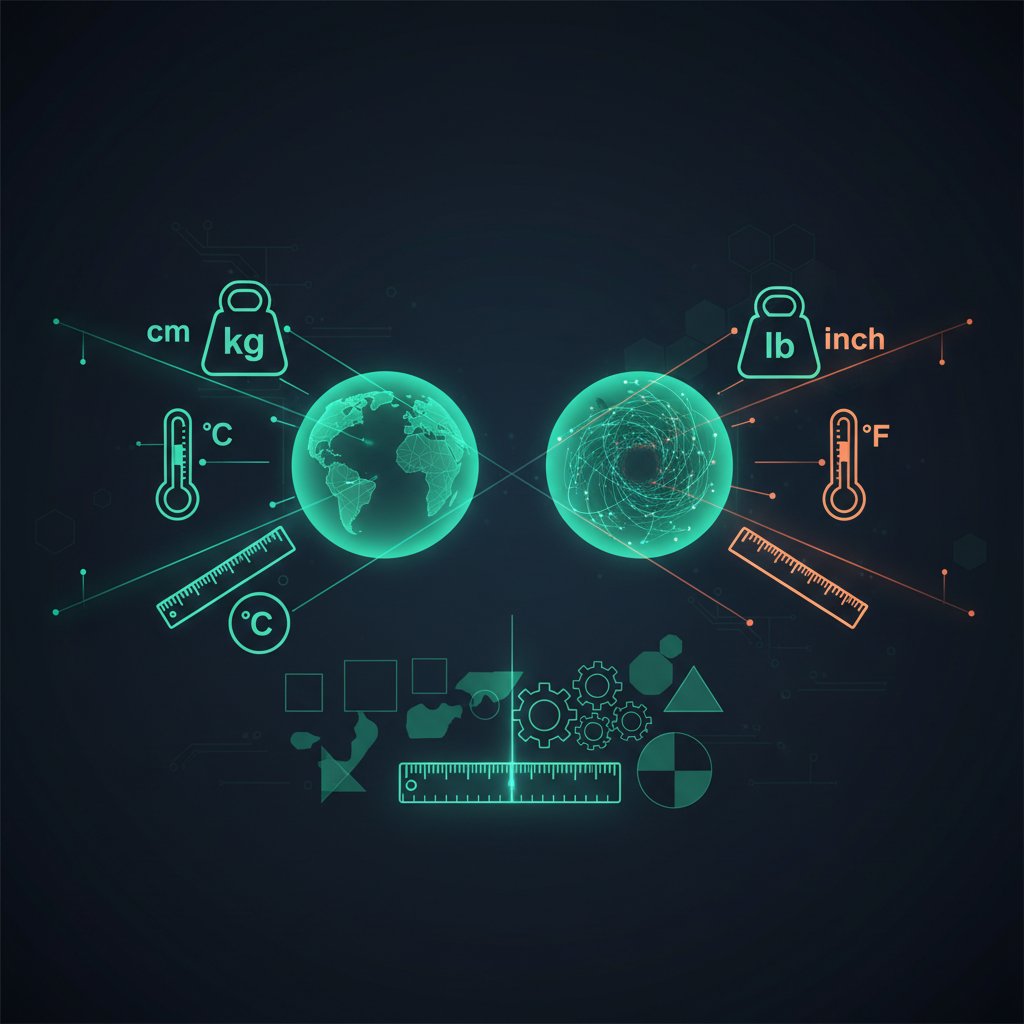
The Global Standoff: An Introduction to Metric and Imperial
In a world more connected than ever, a fundamental division quietly shapes our daily lives, our industries, and even our scientific endeavors. It’s the persistent, often confusing, clash between the metric and imperial systems of measurement. Why is it that a recipe from the United States calls for a “cup” of flour, while one from France specifies “120 grams”? Why do we measure road distances in kilometers in most of the world, but in miles in a select few countries? This is the story of two competing languages of measurement, each with a rich history and a passionate set of advocates.
The vast majority of the world has embraced the logical, decimal-based simplicity of the metric system, officially known as the International System of Units (SI). Yet, the imperial system, with its roots in ancient and often anthropocentric measures, holds firm in key regions, most notably the United States. This divide is more than just a matter of preference; it has real-world consequences, from minor daily inconveniences to catastrophic engineering failures. This article explores the history, logic, and stubborn persistence of these two systems, why the world can’t seem to agree on a single standard, and how to navigate this divided landscape. For anyone who has ever found themselves puzzled by a foreign measurement, or simply curious about the world’s enduring quirks, this deep dive is for you. Learn more about our global community and our tools on our home page.
The Metric System: A Revolution in Measurement
At its core, the metric system is a model of simplicity and order. It was designed from the ground up to be rational, logical, and easy to use. Its entire architecture is built on the number 10, which makes conversions between different scales of measurement incredibly straightforward.
Origins in the Age of Enlightenment
The metric system was born from the intellectual fervor of the French Revolution in the late 18th century. Before this, France (and the rest of Europe) was a chaotic patchwork of measurement systems. A “foot” in one town could be different from a “foot” in the next, and units were often defined by royal decree or local tradition, creating massive confusion for trade and science. The revolutionaries sought to sweep away this old, irrational system and replace it with one based on reason and nature. The goal was, as the French philosopher Marquis de Condorcet put it, a system “for all people, for all time.”
A commission of France’s most brilliant scientists was assembled. They decided the new system’s base unit of length, the meter, should be derived from the Earth itself. It was originally defined as one ten-millionth of the distance from the North Pole to the Equator. For mass, they created the gram, defined as the mass of one cubic centimeter of water at its densest point. Volume was linked directly to this with the liter, defined as the volume of one cubic decagram (1,000 cubic centimeters) of water.
The Power of Prefixes
The true genius of the metric system lies in its prefixes. Instead of inventing new names for larger or smaller units, the system uses a standard set of prefixes that apply universally to any base unit (meter, gram, liter, etc.).
- Kilo- means 1,000 (a kilometer is 1,000 meters; a kilogram is 1,000 grams).
- Hecto- means 100.
- Deca- means 10.
- Deci- means 0.1 (a deciliter is one-tenth of a liter).
- Centi- means 0.01 (a centimeter is one-hundredth of a meter).
- Milli- means 0.001 (a milligram is one-thousandth of a gram).
This structure means that converting between units is as simple as moving a decimal point. To convert 1.87 kilometers to meters, you just multiply by 1,000 (move the decimal three places to the right) to get 1,870 meters. This simplicity is why the metric system, now known as the International System of Units (SI), has become the universal language of science, medicine, and international trade.
The Imperial System: A Tapestry of Tradition
If the metric system is a product of pure logic, the imperial system is one of history, culture, and human experience. It’s a collection of units that evolved over centuries, with roots stretching back to the Roman Empire and Anglo-Saxon England. Its units are often relatable to human scale or natural objects, which gives them a certain intuitive, albeit inconsistent, charm.
From Barleycorns to King’s Feet
The imperial system’s units tell a story of how people measured the world before standardized science. Many units were based on body parts or common objects:
- The inch: Originally defined as the width of a man’s thumb at the base of the nail, it was later standardized by King Edward II of England in the 14th century as “three grains of barley, dry and round, placed end to end.”
- The foot: While its name suggests its origin, the length varied wildly depending on whose foot was being used. It was eventually standardized as 12 inches.
- The yard: Legend holds that King Henry I of England decreed a yard was the distance from the tip of his nose to the end of his outstretched thumb.
- The acre: A term still used in land measurement today, an acre was originally the amount of land that could be plowed by a yoke of oxen in one day. You can easily convert between acres, hectares, and other area units with a powerful land calculator.
British Standardization and its Legacy
This hodgepodge of measurements was eventually codified by the British Empire. The Weights and Measures Act of 1824 and subsequent updates created the British Imperial System, establishing definitive standards for units like the pint, quart, gallon, ounce, pound, and stone. As the British Empire expanded, it took this system with it across the globe, from North America to Australia to parts of Africa and Asia.
The core challenge of the imperial system is its lack of consistent conversion factors. There are 12 inches in a foot, 3 feet in a yard, and 1,760 yards (or 5,280 feet) in a mile. For weight, there are 16 ounces in a pound. For volume, a pint is 20 fluid ounces in the British system but 16 in the US customary system—a key difference. Memorizing these arbitrary numbers is a rite of passage for schoolchildren in imperial countries, but it stands in stark contrast to the metric system’s simple powers of 10.
The Great Divide: Metric vs. Imperial Countries Today
The modern world is overwhelmingly metric. Of the nearly 200 countries on Earth, only three have not officially adopted the metric system as their primary system of measurement: the United States, Liberia, and Myanmar.
This simple fact, however, hides a more complex reality. The influence of the imperial system persists in several "in-between" countries, a legacy of their historical ties to the British Empire.
- The United Kingdom: The UK is perhaps the most prominent example of a country in metric limbo. It officially began a policy of metrication in 1965, and metric units are mandatory for most trade. Speed limits are in miles per hour, beer and milk are sold in pints, and people commonly state their height in feet and inches and their weight in stone and pounds.
- Canada: Canada also has a dual system. Officially, it adopted the metric system in the 1970s. Groceries are sold in grams and kilograms, and gasoline in liters. However, many Canadians still use imperial units in daily conversation, particularly for height and weight. Construction materials are often sold in imperial dimensions (e.g., a 2x4 piece of lumber).
- Australia and New Zealand: Both countries completed a successful transition to the metric system in the 1970s and 80s, but some imperial vestiges remain in colloquial language, such as referring to a baby’s birth weight in pounds and ounces.
In contrast, the rest of Europe, Asia, Africa, and South America are thoroughly metric. This global uniformity is critical for international supply chains, scientific collaboration, and manufacturing. For companies operating in a global market, the metric system is the default language.
Why Do Some Countries Cling to the Imperial System?
With the clear advantages of the metric system in a globalized world, why does the United States, a global leader in science and technology, hold so firmly to its imperial past? The reasons are a complex mix of culture, cost, and history.
The United States: A Special Case
1. Cultural Inertia and Identity: The imperial system is deeply woven into the fabric of American culture and language. People think in feet, miles, pounds, and gallons. Common phrases like "go the extra mile," "an ounce of prevention is worth a pound of cure," and "inch by inch" are part of the daily lexicon. To many, switching to metric feels foreign and unnatural. It’s what people were taught, what they use to build houses, and how they cook their family recipes.
2. Immense Cost of Conversion: The financial cost of a full national conversion is staggering. It would involve changing millions of road signs, retooling countless factories, rewriting technical manuals and building codes, and re-educating the entire population. Estimates from the 1970s put the cost in the hundreds of billions of dollars in today’s money. For many, the argument "if it ain’t broke, don’t fix it" is a powerful one, especially when the price tag is so high.
3. A History of Voluntary, Not Mandatory, Change: Thomas Jefferson was an early proponent of a decimal-based system for the newly formed United States, but his proposal was not adopted. By the time the metric system gained international traction, the U.S. had already industrialized using imperial units. In 1975, Congress passed the Metric Conversion Act to coordinate and encourage the voluntary use of the metric system. However, its voluntary nature was its downfall. Without a clear mandate, public adoption was lukewarm, and a strong anti-metric sentiment even emerged, viewing it as a foreign imposition. The effort largely fizzled out by the early 1980s.
Despite this, metrication has been slowly creeping into American life. The scientific, medical, and automotive industries are largely metric. Many consumer products display dual units, with soda famously sold in 2-liter bottles and nutrition labels listing fats and sugars in grams.
Real-World Consequences of a Divided System
The use of two competing measurement systems is not just a quirky inconvenience. In a world where precision matters, conversion errors have led to spectacular failures and costly mistakes.
The Mars Climate Orbiter (1999)
This is the most famous cautionary tale. In 1999, a $125 million NASA spacecraft, the Mars Climate Orbiter, was lost during its approach to the red planet. An investigation revealed a shocking but simple cause: a "measurement mismatch." The engineering team at Lockheed Martin Astronautics, which built the orbiter, used imperial units (pound-seconds) for their thrust calculations. The team at NASA’s Jet Propulsion Laboratory, which operated the spacecraft, had programmed the navigation software to expect those values in metric newtons. The discrepancy caused a series of incorrect trajectory adjustments. Instead of entering a stable orbit, the orbiter entered Mars’ atmosphere at too low an altitude and was destroyed by friction and heat. A multi-million dollar mission was lost due to a basic conversion error.
The "Gimli Glider" (1983)
Another dramatic incident occurred in 1983 involving Air Canada Flight 143. The Boeing 767 aircraft ran out of fuel at an altitude of 41,000 feet over central Canada. The reason was a fueling miscalculation made during Canada’s transition from the imperial to the metric system. The ground crew needed to calculate the required fuel in kilograms but were mistakenly given the conversion factor for pounds to liters instead of kilograms to liters. As a result, the plane took off with less than half the fuel it needed. In a remarkable feat of airmanship, the pilots managed to glide the powerless jet to a safe landing at a decommissioned airbase in Gimli, Manitoba. The incident earned the aircraft the nickname “Gimli Glider.”
Friction in International Trade
On a more mundane but economically significant level, the dual-system world creates constant friction in global trade. U.S. manufacturers often need to create two versions of their products and packaging: one for the domestic market (in ounces, inches) and one for the international market (in grams, millimeters). This adds complexity and cost to design, manufacturing, and logistics. A simple error in converting packaging dimensions can mean a shipment of goods is rejected at a foreign port, leading to financial losses and supply chain disruptions.
A Comparison Table: Metric vs. Imperial at a Glance
To understand the fundamental differences in their architecture, a side-by-side comparison is incredibly useful. The following table breaks down the core attributes of each system.
| Feature | Metric System (SI) | Imperial System |
|---|---|---|
| Base Unit (Length) | Meter (m) | Foot (ft) |
| Base Unit (Mass) | Gram (g) | Pound (lb) |
| Base Unit (Volume) | Liter (L) | Gallon (gal) |
| Logic | Decimal-based (all units are powers of 10) | Arbitrary and inconsistent conversion factors (e.g., 12, 3, 1760) |
| Prefix System | Standardized and universal (kilo-, centi-, milli-) | No prefix system; each unit has a unique name (inch, foot, yard, mile) |
| Global Usage | Official system for over 95% of the world's countries. | Official system in only 3 countries (USA, Liberia, Myanmar). |
| Scientific Use | The universal standard for all scientific and medical fields. | Rarely used; requires conversion to metric for international collaboration. |
The Future of Measurement: An Inevitable Shift?
Is a fully metric world inevitable? Many signs point in that direction, even in the steadfastly imperial United States. Globalization is a powerful force for standardization. As supply chains become more interconnected and more engineers and scientists are educated in the metric system, the pressure to conform grows. Companies that operate globally have a strong financial incentive to use a single, universal system of measurement.
The digital age is also accelerating this slow shift. Software and automated systems can handle conversions seamlessly in the background, but designing those systems around a single standard is far more efficient. As younger generations grow up in a digitally native and globally-aware world, the cultural attachment to imperial units may slowly weaken. The process is likely to be one of slow, voluntary evolution rather than a sudden, mandated change.
Practical Tools for a Divided Measurement World
Until a single global standard is universally adopted, we will all continue to live in a world with two major systems. This means that at some point, nearly everyone will need to convert from one system to another. Whether you are an American trying to follow a European baking recipe, a Canadian contractor ordering materials from the U.S., or an online shopper trying to figure out if a piece of furniture will fit in your room, accurate conversions are essential.
This is where digital tools become indispensable. A reliable online unit converter removes the guesswork and the risk of human error. Instead of memorizing that one mile is 1.60934 kilometers or that a kilogram is 2.20462 pounds, you can get a precise answer in an instant. These tools bridge the gap between the two systems, promoting clarity and preventing the kinds of small mistakes that can lead to big problems. To dive deeper into interesting topics like this one, be sure to visit our company blog.
Conclusion: One World, Two Systems, and the Path Forward
The metric and imperial systems represent two different philosophies of measurement: one born of revolutionary logic, the other of historical evolution. The metric system’s simplicity and global adoption make it the undisputed champion of science and commerce. Yet, the imperial system endures, preserved by the powerful forces of culture, cost, and habit, particularly in the United States.
The debate over which is "better" often misses the point. In our interconnected world, the real challenge is not choosing a winner, but managing the division effectively. The story of the Mars Climate Orbiter is a stark reminder that clear communication and accurate conversion are critical. As the world continues to shrink, the push for a single, universal standard will likely grow stronger. In the meantime, understanding the differences between the two systems and utilizing reliable tools to navigate them is the smartest path forward for everyone.
Frequently Asked Questions (FAQ)
-
Why doesn't the US switch to the metric system?
The primary reasons are the immense cost of converting infrastructure, industrial machinery, and legal documents; strong cultural inertia and public attachment to the imperial system; and the failure of past voluntary conversion efforts to gain national traction.
-
Which system is better, metric or imperial?
Scientifically and for purposes of international trade, the metric system is objectively superior due to its logical, decimal-based structure, which makes calculations and conversions simple. For everyday use, the "better" system often comes down to familiarity and what a person is used to.
-
How many countries officially use the imperial system?
Only three countries have not officially adopted the metric system as their primary standard: the United States, Liberia, and Myanmar. However, imperial units are still used colloquially or for specific, traditional purposes in other countries like the UK and Canada.
-
Was the Mars Climate Orbiter loss really due to a metric-imperial mix-up?
Yes, absolutely. It is one of the most famous and costly real-world examples of a conversion error. The ground control software used imperial units (pound-seconds) while the spacecraft’s software expected metric units (newton-seconds), causing the orbiter to burn up in Mars' atmosphere.
-
What is the single biggest advantage of the metric system?
Its simplicity and consistency. Because all units are based on powers of 10, converting between them (e.g., from meters to kilometers or grams to milligrams) only requires moving a decimal point. This dramatically simplifies calculations in science, engineering, and education.