US Minimum Wage Annual Salary 2026: Complete Earning Guide
You accepted a job offer at minimum wage last week. The manager said "$7.25 an hour," you nodded, did some quick mental math, and started wondering: will this cover rent, groceries, and the car payment? Most people spend their entire first week on the job without calculating the full annual number, and the paycheck hits differently when the figure finally lands. Whether you're a new worker in the US, someone helping a family member evaluate an offer, or a global reader trying to understand American wages, knowing the US minimum wage annual salary 2026 gives you concrete numbers to plan with. This article breaks down the federal rate, state differences, real take-home pay, and what the numbers mean in daily life.
What Is the Federal Minimum Wage in 2026?
The federal minimum wage sits at $7.25 per hour in 2026. Congress last raised this rate in July 2009, leaving it unchanged for over 15 years. The Fair Labor Standards Act (FLSA) sets this floor and applies it to most private and public sector employees nationwide.
Here's the thing: the federal rate is a floor, not a ceiling. States, cities, and counties set their own rates above it, and employers must pay whichever figure is higher. The US minimum wage annual salary 2026 calculation starts here but rarely ends here.
Why hasn't the federal rate moved? Periodic congressional attempts to raise it have stalled. Meanwhile, inflation has steadily eroded the purchasing power of $7.25/hour. In 1968, the wage floor's purchasing power equaled over $13/hour in today's dollars the current federal number sits at roughly half its historical peak.
Who the Federal Rate Covers
Not every worker falls under this rule. The FLSA minimum wage applies to:
Full-time and part-time employees at covered businesses
Workers at companies with $500,000 or more in annual revenue
Employees engaged in interstate commerce
Farm workers, small business employees under the revenue threshold, and tipped workers operate under separate rules. Run your own hourly-to-annual figures instantly with the free Salary Calculator at QuickConvertIO no signup required.
How Much Is US Minimum Wage Per Year in 2026?
Here's the calculation everyone wants first.
Formula: Hourly Rate x 40 hours x 52 weeks = Annual Salary
At the federal minimum: $7.25 x 40 x 52 = $15,080/year gross
The US minimum wage annual salary 2026 at the federal level reaches $15,080 before any deductions. Hours worked change everything, so here are four real scenarios showing the full range:
Example 1: Situation: Full-time worker, federal minimum wage ($7.25/hour) Calculation: $7.25 x 40 x 52 = $15,080/year
Example 2: Situation: Part-time (20 hours/week), federal minimum wage Calculation: $7.25 x 20 x 52 = $7,540/year
Example 3: Situation: Full-time worker in California ($16.50/hour) Calculation: $16.50 x 40 x 52 = $34,320/year
Example 4: Situation: Full-time worker in Washington State ($16.28/hour) Calculation: $16.28 x 40 x 52 = $33,862/year
The income gap between a federal minimum wage state and a high-wage state adds up to nearly $20,000 per year. Where you work carries almost as much financial weight as the hourly rate on the offer letter.
Seasonal workers and those with variable hours get a different number each year. Plug your actual hours into QuickConvertIO's free Salary Calculator and get your accurate yearly estimate in seconds.
Minimum Wage by State in 2026: Full Breakdown
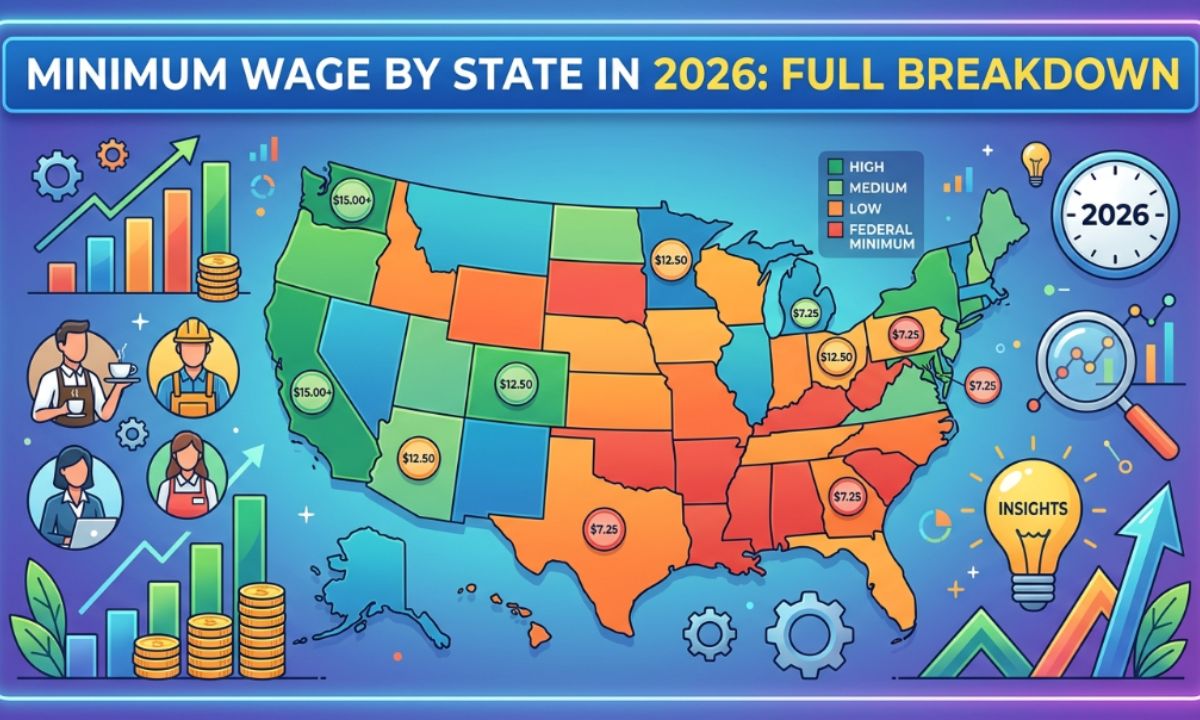
Over 30 states pay above the federal $7.25/hour floor. Several states index their wages to inflation, triggering automatic annual increases without requiring new legislation each year.
Here's a comparison of hourly rates and annual salaries across key states:
State 2026 Hourly Rate Annual Salary (40 hrs/week) California $16.50 $34,320 Washington $16.28 $33,862 New York $16.00 $33,280 Colorado $14.81 $30,804 Florida $13.00 $27,040 Texas $7.25 $15,080 Georgia $7.25 $15,080 Wyoming $7.25 $15,080
Workers in Texas, Georgia, and Wyoming earn the lowest US minimum wage annual salary 2026 federal law allows. A California worker doing identical hours earns $19,240 more per year. Location shapes earning potential at minimum wage more than almost any other factor.
States with scheduled increases, like New Jersey and Illinois, see their rates rise each year through cost-of-living formulas. Always verify the current rate for your specific state before locking in your annual figure.
City and County Minimum Wages Set Above State Law
Here's something most articles skip entirely: your city wage might sit higher than both the federal AND state rate.
Cities and counties across the US set their own minimum wages independently. When a local ordinance exceeds state law, the local rate applies. Workers in high-cost urban areas often benefit from these protections without realizing it.
Here are real city-level rates and their annual impact:
Example 5: Situation: Full-time worker in Seattle, WA (large employer rate: $19.97/hour) Calculation: $19.97 x 40 x 52 = $41,537/year
Denver, CO: $18.29/hour Annual: $18.29 x 40 x 52 = $38,043/year
New York City, NY: $16.50/hour minimum Annual: $16.50 x 40 x 52 = $34,320/year
The rule is straightforward: the highest applicable rate wins. If your city requires $18/hour and your state sets $14, your employer pays $18. No negotiation involved.
Think of it this way: the job posting lists one rate, but three layers of law govern what your employer must pay. Federal, state, and local rules all interact. Your actual US minimum wage annual salary 2026 might look different from the federal figure once you factor in your city's local ordinance.
Minimum Wage After Taxes: Your Real Take-Home Pay in 2026
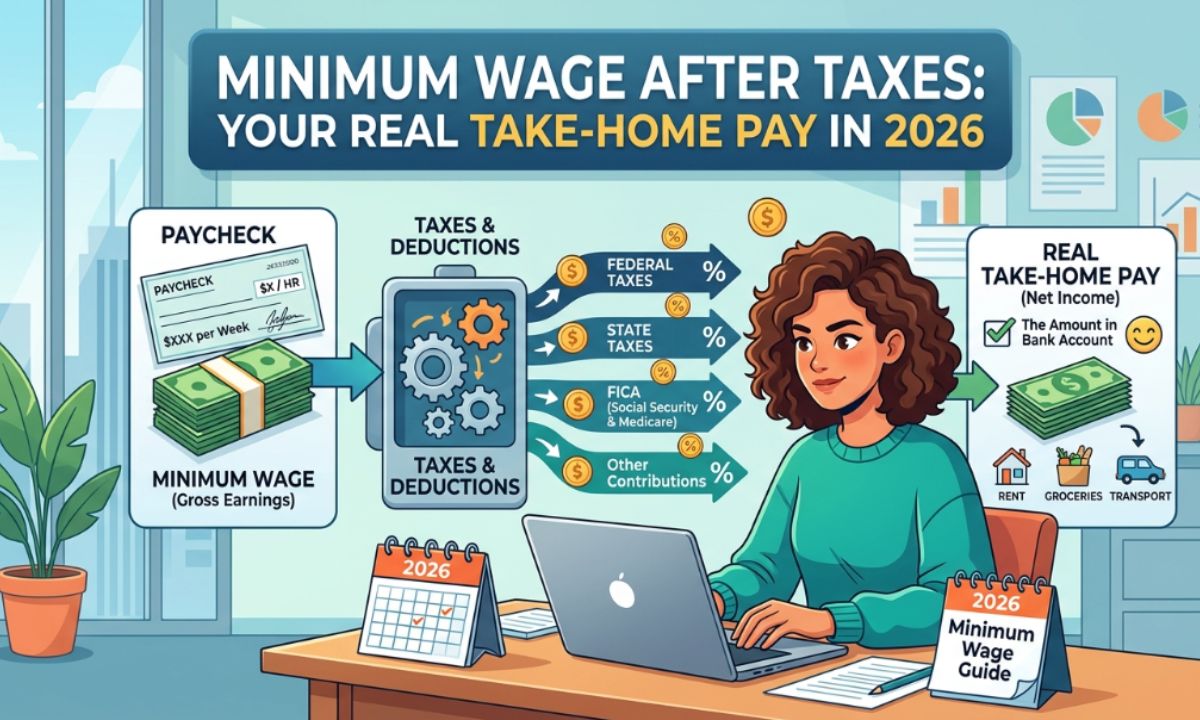
The gross figure gets all the attention. The net figure is what pays rent.
A full-time federal minimum wage worker earns $15,080 per year gross. This falls near the federal standard deduction for single filers (approximately $14,600 for 2025-2026), so federal income tax exposure stays minimal. Other deductions apply regardless.
Two Taxes Every Worker Pays First
Every paycheck carries these deductions before anything else:
Social Security tax: 6.2% of gross wages
Medicare tax: 1.45% of gross wages
State income tax varies widely. Workers in Texas, Florida, and Nevada pay zero state income tax. Workers in California and New York face rates ranging from 3% to over 9%.
Net Pay Example (Federal Minimum Wage, Zero-Tax State):
Deduction Amount Gross Annual Salary $15,080 Social Security (6.2%) -$935 Medicare (1.45%) -$219 Federal Income Tax (estimate) -$128 Estimated Take-Home ~$13,800/year
In a high-income-tax state, take-home drops closer to $12,500. The US minimum wage annual salary 2026 at the federal level delivers real take-home pay between $12,500 and $13,800, depending on your state. Build your budget around the lower figure to stay ahead.
Common Mistake: Most workers calculate $15,080 and build their entire budget around it. After Social Security, Medicare, and state taxes, the figure landing in your bank account sits closer to $12,500 to $13,800. Planning around gross income leads directly to overdrafts and missed bills.
Tipped Workers: A Different Minimum Wage Entirely
Federal law allows employers to pay tipped employees as little as $2.13 per hour. The federal tipped minimum wage has sat frozen at this figure since 1991, over three decades without an adjustment.
Understanding the tipped worker exception is key to a complete US minimum wage annual salary 2026 picture, especially for anyone in food service, hospitality, or delivery roles.
Here's how it works: tips must bring a tipped worker's total hourly earnings up to the standard $7.25/hour minimum. When tips fall short, the employer must legally cover the gap. On slow shifts, effective hourly pay hovers near the floor even after employer top-ups.
Annual Income Calculation for Tipped Workers
Example (Federal Tipped Rate, Full-Time Hours): Situation: Tipped worker at $2.13/hour base, 40 hrs/week, 52 weeks Calculation: $2.13 x 40 x 52 = $4,430/year in guaranteed base wages
Tips carry the rest. Annual income for tipped workers swings based on restaurant traffic, shift type, and season.
Several states eliminated the tip credit entirely:
California: tipped workers earn the full $16.50/hour state minimum
Oregon, Alaska, Montana, Minnesota: no tip credit permitted under state law
Workers in these states earn a stable, predictable annual wage regardless of nightly tip volume. Workers in tip-credit states face income uncertainty at every shift.
Read More:
Minimum Wage vs. Living Wage: Is It Enough to Live On in 2026?
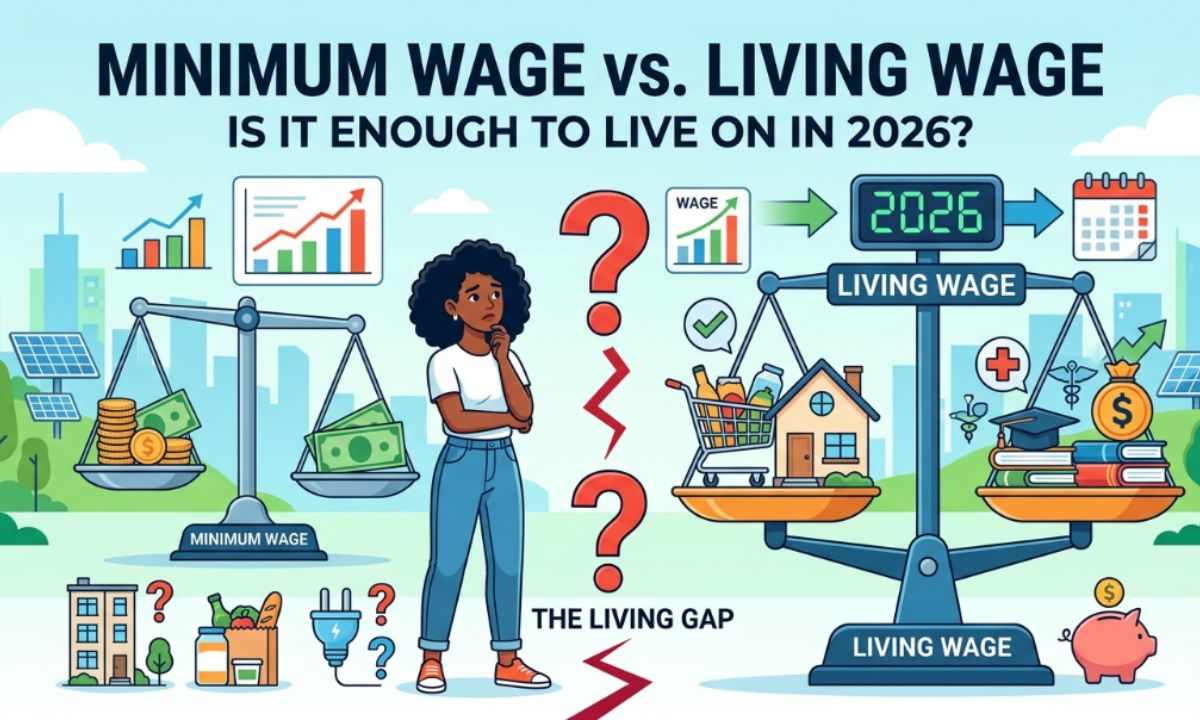
The MIT Living Wage Calculator estimates the income needed for a single adult to cover basic expenses without public assistance. The figures reveal a wide gap between the minimum wage and what daily life costs.
Here's how the numbers compare across major US cities:
Location Living Wage (Single Adult/Year) Minimum Wage Annual Gap New York, NY $56,326 $15,080 (federal) -$41,246 Los Angeles, CA $52,041 $34,320 (CA rate) -$17,721 Dallas, TX $42,328 $15,080 (federal) -$27,248 Des Moines, IA $35,568 $15,080 (federal) -$20,488
The short answer is: the US minimum wage annual salary 2026 at the federal level doesn't meet basic survival costs in any US metro area, according to MIT's data.
Workers at this income level typically manage through shared housing, multiple income streams, government assistance programs, or by living in lower-cost rural areas. Even in Des Moines, one of the more affordable US cities, a full-time federal minimum wage worker falls $20,488 short of the living wage threshold. The rent and grocery bills don't adjust to match the federal floor.
US Minimum Wage Annual Salary Compared Globally in 2026
The US federal rate looks thin when placed alongside peer nations. Most developed economies set national minimum wages significantly above $7.25/hour.
Here's how the US minimum wage annual salary 2026 compares globally at full-time equivalent hours:
Country Min. Hourly Wage (USD approx.) Annual Equivalent Australia $14.50 $30,160 United Kingdom $14.70 $30,576 Germany $13.80 $28,704 Canada (federal) $12.30 $25,584 United States $7.25 $15,080
Australia's minimum wage sits close to double the US federal floor. Both the UK and Germany pay more than $13/hour at the national level, producing annual figures nearly double the US federal minimum.
Purchasing power parity adds important context here. Healthcare in the UK and Australia is publicly funded, meaning workers keep a greater share of their wages. In the US, private health insurance frequently costs $300 to $600 per month, eating directly into annual take-home income and widening the effective gap further.
For readers outside the US, use the free Currency Converter at QuickConvertIO to convert $7.25/hour or $15,080/year into your home currency for a direct real-world comparison.
Frequently Asked Questions
What is the minimum wage in the US per year in 2026?
At the federal rate of $7.25/hour, a full-time worker earns $15,080 per year before taxes. State and local rates push this higher depending on your location, with California workers at the same hours earning $34,320/year.
Which state has the highest minimum wage annual salary in 2026?
California, Washington, and New York lead the country. California's $16.50/hour rate translates to $34,320/year for a full-time worker, more than double the federal annual figure.
Does the federal minimum wage change in 2026?
The federal minimum wage stays at $7.25/hour in 2026. Congress has not passed an increase. Many states continue raising their own rates through scheduled annual increases or inflation-linked cost-of-living adjustments.
How much do tipped workers earn annually under federal minimum wage law?
The federal tipped base rate is $2.13/hour, equaling $4,430/year in guaranteed base wages. Tips must bring total hourly earnings up to $7.25, with the employer legally required to cover any shortfall.
Is the US minimum wage annual salary 2026 enough to afford rent?
In most cities, no. The National Low Income Housing Coalition estimates workers need to earn between $20 and $35/hour to afford a modest two-bedroom apartment in most US metro areas. The federal annual figure of $15,080 covers a fraction of those housing costs.
Final Thoughts
The federal number is $15,080. Your state number might be double. Your city's number might sit higher still. After taxes, the amount hitting your bank account lands $1,500 to $2,500 below even the gross figure.
The US minimum wage annual salary 2026 tells a different story depending on whether you work in Seattle, Dallas, or rural Wyoming. Your earnings depend on state law, local ordinances, your hours, and your tax situation all working together.
Next time you see an hourly rate on a job posting, run the full annual calculation, check your state and city rate, and factor in your realistic take-home. You'll know exactly what the offer is worth before you walk through the door.